Chapter 9: The Sermon

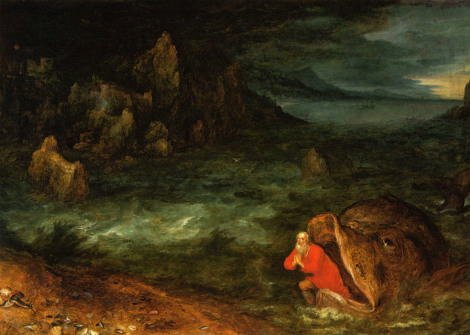
Jonah and the Whale Jan Brueghel the Elder, 1887

Jonah Leaving the Whale, painted by Jan Brueghel the Elder in 1600

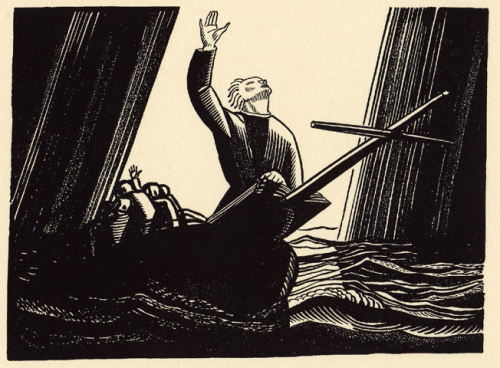
Father Mapple delivers his sermon on the story of Jonah – the Biblical tale that Moby-Dick evokes more than any other. Not just in the prominent presence of the whale, but in the themes of a man defying his fate, and struggling to avoid his fated destiny. If you haven’t read the story of Jonah, you should, especially if you want to understand Moby-Dick.

I’m far from a church-going man, but I regularly attended Mass all the way through my high school graduation. I don’t recall the Book of Jonah coming up even once, though I’m sure it did at some point. It’s an easy story to remember: a man defies God, is swallowed whole by a whale, then released when he prays for forgiveness and deliverance. But it’s very much an Old Testament story, with an angry and vengeful God, with little relevance to the kind of happy loving messaging that modern Christianity focuses on.

The sermon that Father Mapple delivers is much more in the spirit of old time 19th Century Christianity, a sermon that doesn’t hold back the fire and brimstone. There’s a fabulous description of Jonah as he seeks a ship to take him across the sea:

Miserable man! Oh! most contemptible and worthy of all scorn; with slouched hat and guilty eye, skulking away from his God; prowling among the shipping folk like a vile burglar hastening to cross the seas. So disordered, self-condemning is his look, that had there been policemen in those days, Jonah, on the mere suspicion of something wrong, had been arrested ere he touched a deck. How plainly he’s a fugitive! no baggage, not a hat box, valise or carpet-bag,-no friends accompany him to the wharf with their adieux.

We shall later see, when Ishmael and Queequeg sail with from Nantucket aboard the Pequod, that they too will have no friends but each other to accompany them to the wharf and say their goodbyes.

What lessons does Father Mapple take from the story of Jonah? The first, that a man who has been punished should first be repentant, and accept the punishment as just:

He goes down in the whirling heart of such a masterless commotion that he scarce heeds the moment when he drops seething into the yawning jaws awaiting him; and the whale shoots-to all his ivory teeth, like so many white bolts, upon his prison. … sinful as he is, Jonah does not weep and wail for direct deliverance. He feels that his dreadful punishment is just. He leaves all his deliverance to God, contenting himself with this, that spite of all his pains and pangs, he will still look toward His holy temple.

This attitude of acceptance is, of course, the complete opposite of that taken by Captain Ahab, who has yet to enter the story. Rather than accepting the loss of his leg, Ahab is consumed by vengeance and rage, ultimately leading himself, his ship and his crew to their deaths.

Yet there is another lesson Father Mapple draws from the story:

Woe to him whom this world charms from Gospel duty! Woe to him who seeks to pour oil upon the waters when God has brewed them into a gale! Woe to him who seeks to please rather than appall! Woe to him whose good name is worth more to him than goodness! Woe to him who, in this world, courts not dishonor!

This could be Ahab’s crew, who recklessly followed their master even as they came to realize he was leading them on a mad quest for vengeance. It could apply to Ahab himself, who allows his own desire for vengeance to direct him rather than the directives laid down by the ship’s owners. It could even be Ishmael, who rather than pursuing a sedate life on land chose to flee to sea.

Yet there is one important and telling way where Jonah’s story parts from that of Moby-Dick. In the end of all his hardships, God is merciful, and Jonah is released from the whale. In Moby-Dick, everyone is punished for the Ahab’s sin, and all drowned, the good and the evil alike. God, or perhaps a more impartial Fate or Destiny, has no mercy in Melville’s world.

For a great rendition of this scene, take a look at Orson Welles as Father Mapple in the movie version of Moby-Dick:

http://www.youtube.com/watch?v=Mog0W6Jwj0Q
 

Chapter 8: The Pulpit

the_pulpit

Father Mapple at the Pulpit, another great illustration by Rockwell Kent

Moby-Dick has a great talent for introducing small characters with great presence. Their are examples of this throughout the book: Elijah, the mentally unbalanced sailor and prophet; the cook, who serves as Stubb’s conscious; the innkeeper who greets Ishmael at his arrival in New Bedford. The most momentous of these may be Father Mapple, the preacher who delivers one of the most important passages of the novel.

The Pulpit serves as his introduction. When we left Ishmael, he and the rest of the congregation waited in the chapel for the arrival of the preacher. Father Mapple’s reputation proceeds him – while he had been a sailor and a harpooneer in his youth, he had dedicated the rest of his life to God and the ministry. Yet he still bears the signs of his previous profession:

Father Mapple was in the hardy winter of a healthy old age; that sort of old age which seems merged into a second flowering of youth, for among all the fissures of his wrinkles, there shown certain mild gleams of a newly developed bloom-the spring verdure peeping forth beneath February’s snow. No one having previously heard his history, could for the first time behold Father Mapple without the utmost interest, because there were certain engrafted clerical peculiarities about him, imputable to that adventurous maritime life he led. When he entered I observed that he carried no umbrella, and certainly had not come in his carriage, for his tarpaulin hat ran down with melting sleet, and his great pilot cloth jacket seemed almost to drag him to the floor with the weight of the water it had absorbed.

Like a sailor, who must perform his duty no matter the weather, Father Mapple does not flinch from enduring the elements in pursuit of his duty. Still more in keeping with his past job is the pulpit from which he preaches, and which he now ascends:

Like most old fashioned pulpits it was a very lofty one, and since a regular stairs to such a height would, by its long angle with the floor, seriously contract the already small area of the chapel, the architect, it seemed, had acted upon the hint of Father Mapple, and finished the pulpit without stairs, substituting a perpendicular side ladder, like those used in mounting a ship from a boat at sea … Halting for an instant at the foot of the ladder, and with both hands grasping the ornamental knobs of the manropes, Father Mapple cast a look upwards, and then with a truly sailor-like but still reverential dexterity, hand over hand, mounted the steps as if ascending the main-top of his vessel … I was not prepared to see Father Mapple after gaining the height, slowly turn round, and stooping over the pulpit, deliberately drag up the ladder step by step, till the whole was deposited within, leaving him impregnable in his little Quebec.

As a side-note, Quebec at the time was a notorious fortress city, also known as the “Gibraltar of North America.”

Father Mapple evokes not only his seafaring past, but also the peculiar loneliness of the sailor by isolating himself at his pulpit. He draws up the ladder behind him, isolating himself from the surrounding world, “for replenished with the meat and wine of the Word, to the faithful man of God, this pulpit, I see, is a self-containing Ehrenbreitstein, with a perennial well of water within the walls.”

ehrenbreitstein

Ehrenbreitstein is a fortress in Germany which still stands today.

What a contrast with Ishmael, a man plagued with doubts and questions! Father Mapple isolates himself with only his faith and the word of God to sustain him, and does so of his own volition. Ishmael, on the other hand, is uncertain of his own future. He has no ties to a profession or a home, and finds himself seeking the sea not because that is his calling, but as a way to salve his own uncertainties and depression.

But there is still more to the pulpit that has not yet been described:

Between the marble cenotaphs on either hand of the pulpit, the wall which formed its back was adorned with a large painting representing a gallant ship beating against a terrible storm off a lee coast of black rocks and snowy breakers. But high above the flying scud and dark-rolling clouds, there floated a little isle of sunlight, from which beamed forth an angel’s face; and this tiny bright face shed a distinctive spot of radiance upon the ship’s tossed deck … “Ah, noble ship,” the angel seemed to say, “beat on, beat on thou noble ship, and bear a hardy helm; for lo! the sun is breaking through; the clouds are rolling off-serenest azure is at hand.”

The message here is clear enough – God provides hope even in the face of greatest adversity. But is God’s help truly there if one’s fate is shipwreck and death? Faith certainly lends little help to the Pequod and its crew at the book’s conclusion.

But there is one final ship-like touch to the pulpit’s design: “Its panelled front was in the likeness of a ship’s bluff bows, and the Holy Bible rested on a piece of scroll work, fashioned after a ship’s fiddle-headed beak.”

Ishmael draws a metaphor of the pulpit as a ship drawing all the world behind it, as the prow draws a boat. “Yes the world’s a ship on its passage out, and not a voyage complete; and the pulpit is its prow.” This is in keeping with Moby-Dick’s focus on fate and destiny – the fate of the world is beyond the control of individuals, and instead in the hands of God. In the view of the Father Mapple’s of the world, this is a good thing.

But consider this passage from the final chapter of Moby-Dick:

Hearing the tremendous rush of the sea-crashing boat, the whale wheeled round to present his blank forehead at bay; but in that evolution, catching sight of the nearing black hull of the ship; seemingly seeing in it the source of all his persecutions; bethinking it-it may be-a larger and nobler foe; of a sudden, he bore down upon its advancing prow, smiting his jaws amid fiery showers of foam.

The prow leads the ship, but not to safety in God’s hands, but to destruction at the jaws of the Whale, which as we shall see in the next chapter can itself be God’s instrument.

Chapter 7: The Chapel

seamensbethel

The real Seamen’s Bethel, still standing in New Bedford today.

Death was not unusual in the whaling business. It could come from a whale itself, as it smashes your flimsy wooden boat to pieces, or from a shipboard accident in the rigging, or from contaminated food. Whalers died from dehydration, from enraged or drunken shipmates, from angry Pacific islanders. It was a dangerous profession, for ordinary whalers as well as those obsessed with an albino nemesis.

Ishmael pays his respects to those who have lost their lives pursuing his chosen profession by visiting a Whalemen’s Chapel, based on the real life Seaman’s Bethel that still stands in New Bedford today.

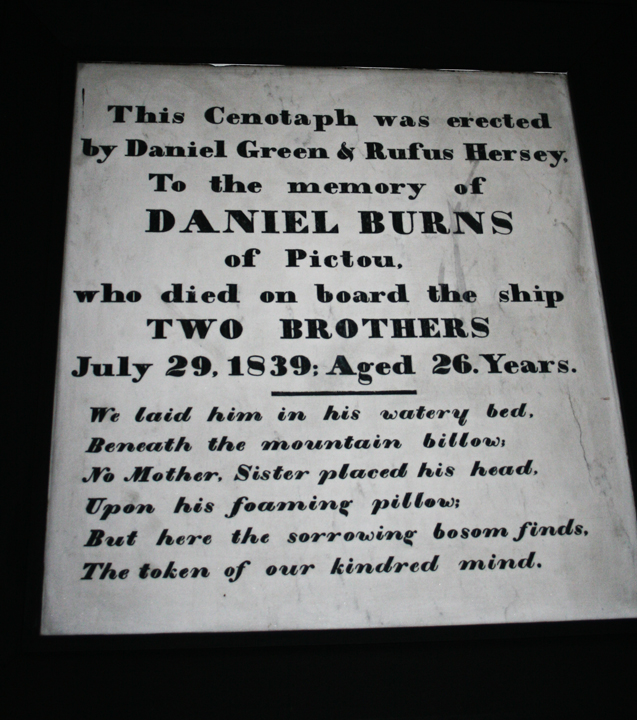
Within the chapel, black-bordered marble tablets bear the names and places of death of New Bedford’s sons lost to the ocean. John Talbot, at the age of 18, lost overboard near the Isle of Desolation. Six men towed out of sight by a whale, in a nameless spot in the Pacific. Those who die at sea will never return to rest at home, and their families would never how they truly died.

Whether any of the relatives of the seamen whose whose names appeared there were now among the congregation, I knew not; but so many are the unrecorded accidents in the fishery, and so plainly did several women present wear the countenance if not the trapping of some unceasing grief, that I feel sure that here before me were assembled those, in whose unhealing hearts the sight of those bleak tablets sympathetically caused the old wounds to bleed afresh.

cenotaph1

Memorial inside of Seamen’s Bethel.

“A small scattered congregation of sailors, sailor’s wives and sailor’s widows” fills the chapel. Even Queequeg is here, despite his proud paganism. It is a doleful, sad crowd, in a doleful, sad place. But to Ishmael the chapel also embodies the hope of remembrance and the eternal life of the soul:

Yes, there is death in this business of whaling–a speechlessly quick bundling of man into Eternity. But what then? Methinks we have hugely mistaken this matter of Life and Death. Methinks that what they call my shadow here on earth is my true substance. Methinks that in looking at things spiritual, we are too much like oysters observing the sun through the water, and thinking that thick water the thinnest of air. Methinks my body is but the lees of my better being. In fact take my body who will, take it I say, it is not me. And therefor three cheers for Nantucket; and come a stove boat and stove body when they will, for stave my soul, Jove himself cannot.

Ishmael has prepared himself for the death, and is ready for it if it comes. But that, of course, is not what God or Fate has in store for him.

Chapter 6: The Street

johnaveryparker_mansion

John Avery Parker Mansion, one of the grand houses built with whaling money in 19th century New Bedford.

It is difficult for those of us alive today to understand the size and vast power of the whaling industry in 19th century America. We imagine it like a large scale fishing operation, generating good livelihoods but not necessarily fortunes. However, nothing can be further from the truth. The closest comparison to the New England whaling industry in the middle of the 19th century is, perhaps, the great oil boom taking place today in North Dakota. Chapter 6 reveals much about both the wealth the whaling industry generates in the towns that depend on it, and the type of people coming in to, with luck, take a piece of that whale money home for themselves.

The chapter opens with a description of the crowds that fill New Bedford’s streets. Not just American sailors, but men from around the world, including “savages outright; many of whom yet carry on their bones unholy flesh.” But even stranger are the farmers and shopkeepers who’ve come to try their hand at whaling. “Green Vermonters and NEw Hampshiremen, all athirst for gain and glory in the fishery.” Yet these newcomers are all too likely to “burst their straps in the first howling gale”.

Yet beyond the crowds there are the great stately mansions that the whale fishery has funded. “A land of oil, true enough … a land, also, of corn and wine.” The whale fishery has transformed this isolated coast of New England into one of the richest places in the country:

In New Bedford, fathers, they say, give whales to their daughters for dowers, and portion off their nieces with a few porpoises a piece. You must go to New Bedford to see a brilliant wedding; for, they say, they have reservoirs of oil in every house, and every night recklessly burn their lengths in spermaceti candles.

Whale oil provided light in the cities of 19th century America, and didn’t power every aspect of civilization as petroleum does today. But imagine how much more light was worth in a world that otherwise relied on campfires and tallow candles, a world where lighting the house all night would be considered recklessly extravagant. It’s easy to see why so much money could be made, not just by the owners and captains of ships but by the crews as well.

Pay in the whaling world was based on a share of the final profits of a voyage. As we’ll see later when Ishmael and Queequeg take ship, a new sailor is promised a “lay”, or a fraction of the final profits. A captain could expect as much as 1/8 of the profits, while new sailors as little as 1/300. But a profitable voyage could provide good money to everyone involved, not to mention several years worth of free food and lodging, to anyone who wished to endure the hardships and life-threatening risks of a whale voyage. For many New Bedford men died in pursuit of the whales that provided their livelihood, as we shall see in the next chapter.


Chapter 5: Breakfast

This chapter is a short one, but reveals much about Melville’s view of whalemen. Like many people who are vastly talented in one area, they are lacking in others. Whalers, who hunt mighty beasts of the sea and sail for years around the Earth, are not terribly conversational around the breakfast table.

Queequeg, of course, is proud and comfortable even around this slightly awkward and quiet table. using his harpoon, he pulls the steaks over to him, and “eschewed coffee and hot rolls, and applied his attention to beefsteaks, done rare.”

Many of the opening chapters of Moby-Dick have a singular focus on food. Sailors would often subsist on the same meal for months and years, so perhaps this is unsurprising for the opening chapters, set on shore. What people eat is perhaps as revealing as how they eat it. Here we see that rather than a table filled with bawdiness and sea-stories, the men are out of their element, and would perhaps prefer to be back at sea.

On an interesting side-note, while searching for information on the Breakfast chapter of Moby-Dick, I stumbled on the below video of a wave crashing into the Moby Dick restaurant in Santa Barbara.

Chapter 4: The Counterpane

counterpane

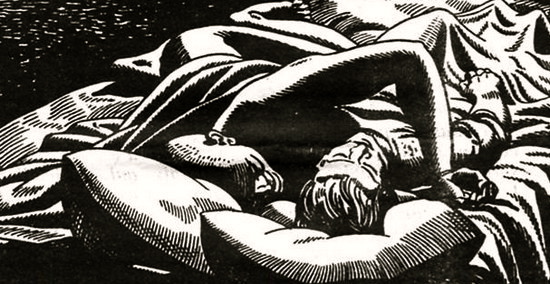
Rockwell Kent’s illustration of Queequeg embracing Ishmael.

Upon waking next morning about daylight, I found Queequeg’s arm thrown over me in the most loving and affectionate manner. You had almost thought I had been his wife. The counterpane was of patchwork, full of odd little parti-colored squares and triangles; and this arm of his tattooed all over with an interminable Cretan labyrinth of a figure, no two parts of which were of one precise shade-owing I suppose to keeping his arm at sea unmethodically in sun and shade, his shirt sleeves irregularly rolled up at various times-this same arm of his, I say, looked for all the world like a strip of that same patchwork quilt.

Many people have commented on the vaguely homoerotic tone of fictional “best buddies” from Sherlock Holmes and John Watson to Batman and Robin. But Ishmael and Queequeg have escaped that scrutiny, despite sharing a bed, sharing possessions, and generally behaving throughout the rest of the novel like a married couple, albeit a chaste one. Despite the fame of Moby-Dick, few people are drawn to comment on their relationship.

The most obvious reason for this is that Ishmael and Queequeg are not the focus of the novel. While their adventures dominate the opening few chapters, they are quickly overshadowed by Ahab and the whale. By the time we meet Ahab, Ishmael and Queequeg are reduced to bit parts in the narrative. However, the extraordinarily close relationship between Ishmael and Queequeg cannot be dismissed as unimportant. It reflects a similar relationship between Melville and the writer Nathaniel Hawthorne, a relationship that not only fueled the creation of Moby-Dick but which continues to provide material for those invested in gossiping about the love lives of dead authors (I count myself among them).

Nathaniel_Hawthorne

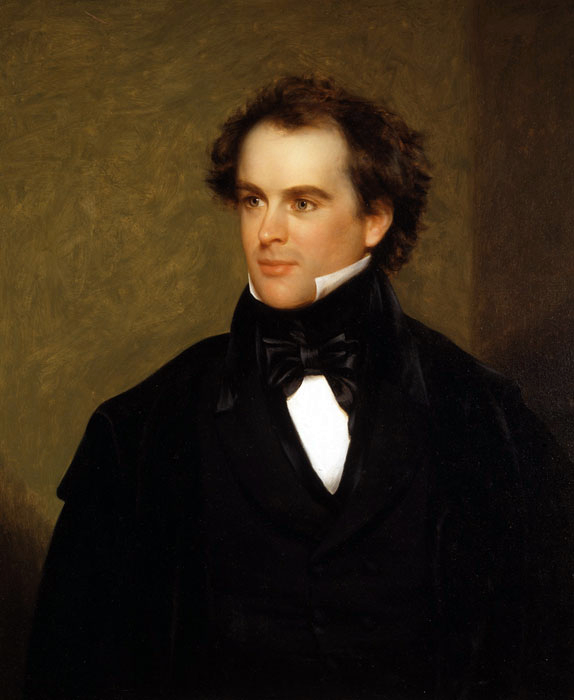
A young Nathaniel Hawthorne, painted by Charles Osgood in 1841

Hawthorne and Melville met in 1850, hiking to the top of Monument Mountain in Massachusetts with a group of writers and publishers. Melville was still coming off the success of his first novel, Typee, an exciting tale of high seas adventure in the South Pacific. His encounter with Hawthorne energized him, and their friendship turns Melville away from the popular adventure stories that had been his literary start and to the much more intellectually ambitious work that is Moby-Dick.

While it is unlikely Melville and Hawthorne were lovers, they were a great deal more than friends. Melville, whose letters to Hawthorne have survived, found in Hawthorne a soul mate, a someone who not only responded encouragingly to Melville’s literary ambitions but brought them to new heights. His letters frequently feature phrases like:

Whence come you, Hawthorne? By what right do you drink from my flagon of life? And when I put it to my lips – lo, they are yours and not mine. I feel that the Godhead is broken up like the bread at the Supper, and that we are the pieces.

and:

Your letter was handed me last night on the road going to Mr. Morewood’s, and I read it there. Had I been at home, I would have sat down at once and answered it. In me divine maganimities are spontaneous and instantaneous — catch them while you can. The world goes round, and the other side comes up. So now I can’t write what I felt. But I felt pantheistic then — your heart beat in my ribs and mine in yours, and both in God’s.

In a worshipful review Melville published anonymously under the name “a Virginian spending July in Vermont”, Melville uses intensely sensual language in reference to his friend:

But already I feel that this Hawthorne has dropped germinous seeds into my soul. He expands and deepens down, the more I contemplate him; and further, and further, shoots his strong New-England roots into the hot soil of my Southern soul.

In addition to their frequent letters, the two writers often visited each other. They lived close by, residing in neighboring towns in Massachusetts, and enjoyed drinking champagne and talking late into the night. Influenced by Hawthorne, who had already published his dense and ambitious The Scarlet Letter, Melville took what was going to be a light hearted account of the South Seas whaling industry and transformed it into a masterwork.

Ultimately the relationship between the two didn’t last, as Hawthorne moved away and their correspondence fell off. However Moby-Dick carries a lasting monument to their friendship on the dedication page:

In Token

of my admiration for his genius,

This book is inscribed

to

NATHANIEL HAWTHORNE

Chapter 3: The Spouter-Inn

If you’ve ever played Dungeons and Dragons, or read a fantasy novel, you’ve seen how an inn always lies at the beginning of an adventure. Here brave companions meet, plots are plotted, and preparations for epic quests are made. Of course inns can be found in other places as well, from the Boar’s Head tavern of Shakespeare’s Henry IV to the Tabard inn of Canterbury Tales. Even the New Testament begins in an inn, albeit an unnamed one. Moby-Dick too has its inn. Here Ishmael meets his closest friend, and a relentless chain of events begins that leads him to his destiny as the last survivor of the Pequod.

spouterinn painting

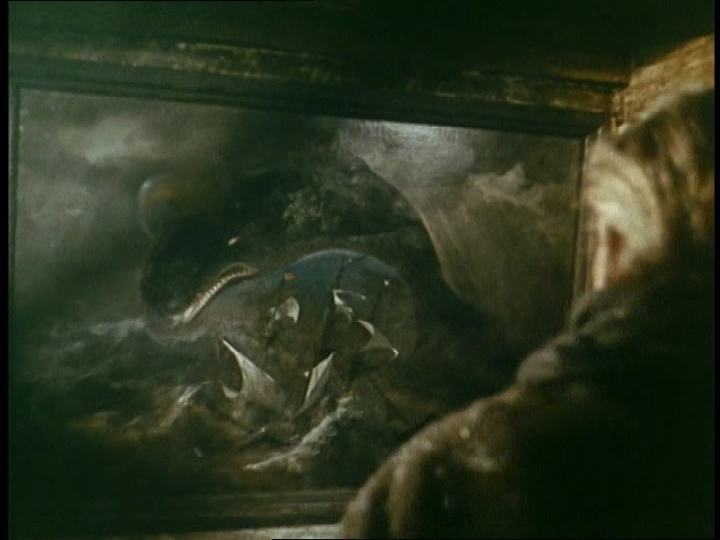
The Spouter-Inn’s whale painting, depicted in the film version of Moby-Dick.

The first thing Ishmael encounters upon entering is a painting, a “boggy, soggy, squitchy picture truly, enough to drive a nervous man distracted.” At first it appears as nothing more than “unaccountable masses of shades and shadows, that at first you almost thought some ambitious young artist, in the time of the New England hags, had endeavored to delineate chaos bewitched.” After peering carefully through the soot and smoke stains that cover its surface, Ishmael soon deciphers a three-masted ship in the midst of a storm, with “an exasperated whale, purposing to spring clean over the craft, is in the enormous act of impaling himself on the three mast-heads.”

Why does Melville devote a solid page to this painting? For one thing it adds to our mental picture of the inn. Dimly lit, and so filled with smoke that it has stained this painting to the point that it is unrecognizable. It also is clearly an image of dread, as we see in Ishmael’s guesses as to the painting’s nature:

-It’s the Black Sea in a midnight gale.-It’s the unnatural combat of the four elements.-It’s a blasted heath.-It’s a Hyperborean winter scene.-It’s the breaking up of the ice-bound stream of Time. But at last all these fancies yield to that one portentous something in the picture’s midst.

The picture isn’t the only decor in the inn. Opposite the painting are hung a number of clubs, spears and other weapons brought back by sailors from around the world, including some “tufted with knots of human hair”. Other implements are famous harpoons and lances, used by legendary whalers or found imbedded in the bodies of slain whales years after they were first flung.

As is common in literary inns, there is no room for the main character. However, he does have the option of sharing a bed with an unnamed harpooneer. Ishmael isn’t a fan of this idea, but would rather share a bed than continue wandering around the frigid town searching for another place to stay. He sits down to supper, “not only meat and potatoes, but dumplings; good heavens! Dumplings for supper!”

As he eats, he begins to hear frightening things about the harpooneer with whom he will be sharing a bed. He is a “dark-complexioned chap”, who eats “nothing but steaks, and likes ’em rare.” Most concerning, the harpooneer is walking about town that night trying to sell a shrunken head, though he isn’t having much success since the New Bedford market is overstocked. Despite that Ishmael is convinced to go to bed, or as the landlord puts it “turn flukes”, and await the arrival of the mysterious man.

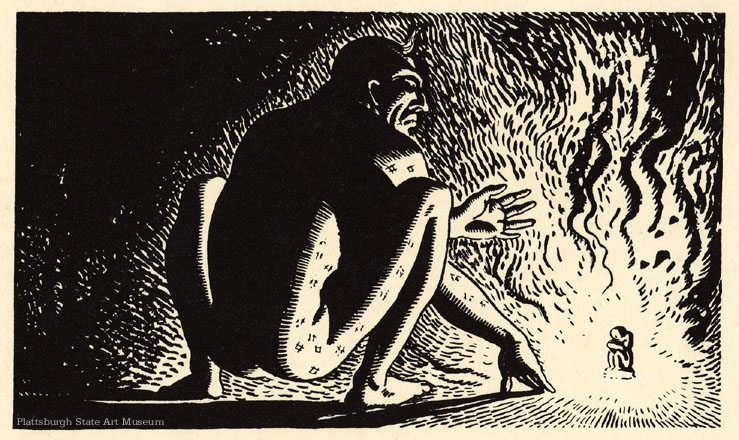
When he finally arrives, Ishmael is terrified. The man’s face is “here and there stuck over with large, blackish looking squares”, and he has a “bald purplish head” that looks “like a mildewed skull”. Soon enough it becomes plain to Ishmael that “he must be some abominable savage or other shipped aboard of a whaleman in the South Seas, and so landed in the Christian country.”

queequeg_praying

Rockwell Kent’s illustration of Queequeg going about his prayers before bed.

Ishmael, still unnoticed in the bed, watches the man burn wood shavings before a wooden idol he takes from his pocket, and then light a pipe and have a smoke. Finally he climbs in bed, and both Ishmael and the mysterious harpooneer, who understandably had not expected anyone to be in his room, freak out. However, Ishmael’s impending death is avoided by the arrival of the landlord, who calms everyone down and introduces Ishmael to Queequeg, the harpooneer. Both settle into bed and go to sleep.

“What’s all this fuss I have been making,” Ishmael thinks, “the man’s a human being just as I am: he has just as much reason to fear me as I have to be afraid of him. Better sleep with a sober cannibal than a drunken Christian.” In a pre-Civil War America, an America where slavery is still legal and Native Americans are being driven from their lands and homes by settlers, Ishmael’s ideas are virtually unique. But later on, we will see that the world of Moby-Dick is far more open than most in the nineteenth century. Men from all over the world take ship aboard the Pequod, and respect each other as comrades despite their different creeds, races and cultures. This is one of the most appealing things about the novel’s setting, where men are judged first on the work they accomplish and the friendships they form with their comrades. But Melville isn’t trying to push a message of social equality or a utopian ideal. He is simply reporting the attitudes and atmosphere in which he worked aboard a whaling ship himself. Yet without realizing it, he is painting a picture of a better society, one that won’t even be hinted at in the rest of the United States for another century.

Ishmael and Queequeg become close friends, and their relationship is the most well developed in the book, with the exception perhaps of that between Ahab and the Whale. But more on that, and on Queequeg, in the next chapter.

Chapter 2: The Carpet-Bag

carpet bag

Authentic 19th century carpet bag. All those sailors and buccaneers in your head? They were hauling around their stuff in colorful bags that looked like this.

Several years ago I spent six months studying abroad in South-East Asia. The night before my flight to Manila, I packed everything I thought I’d need into a suitcase, the modern version of the carpet-bag. As I packed, I was filled with both excitement and anxiety. Excitement because I was about to embark on an entirely new adventure, and anxiety because I would be cut off from everyone who I knew, adrift in an unfamiliar culture.

Of course I wouldn’t really be cut off – I had the phone, the Internet, and the mail. I had family members in Manila, and would have plenty of opportunities to make new friends once I arrived in the Philippines. I would be far away, but hardly cut off, either from home or from humanity in general.

Imagine how much scarier it would be to pack your bags for a whaling voyage. There would be no contact with your family or friends once you left. Your clothes would have to last you not just a few months, but several years. During that time your only companions would be the rest of the crew – whaling ships were packed with enough food and water to go months without needing to stop to re-supply. While sailing around the world, you would hardly ever step ashore, leaving the ship only to lower away and do your best to slay a leviathan that could kill you with a flick of its tail.

Ishmael captures a bit of that anxiety as he wanders about New Bedford. He planned to take a ferry to the island of Nantucket, and there find a berth on a whaling ship. But he has missed the ferry, and the next one doesn’t leave until the day after tomorrow. Lost in an unfamiliar town, dragging his carpet-bag, he seeks a place to sleep that he can afford on his meager budget. He turns away from two pricey inns, The Crossed Harpoons and the Sword-Fish Inn, before stumbling on a black church, which he mistakes for an inn:

It seemed the great Black Parliament sitting in Tophet. A hundred black faces turned round in their rows to peer; and beyond, a black Angel of Doom was beating a book in the pulpit. It was a negro church; and the preacher’s text was about the blackness of darkness, and the weeping and wailing and teeth-gnashing there. Ha, Ishmael, muttered I, backing out, Wretched entertainment at the sign of “The Trap!”

This is definitely one of those racially problematic passages one runs into all the time in novels by dead white men from the 19th century, but as usual in Moby-Dick, it’s more complicated than simple racism. One of the book’s dominant themes is whiteness, but whiteness as something unnatural and threatening, something to be feared and hated. The White Whale, the object of Captain Ahab’s obsessive vengeance, is terrifying partly for his unnatural coloring. Blackness, however, is equally threatening in its strangeness – Ishmael is frightened and uncomfortable, and quickly flees. Melville uses this scene to begin establishing his motif of whiteness vs. blackness, using black Americans as a symbol to do so. Race doesn’t play a dominant role in Moby Dick, but it is present – a great essay by David Cope has more on the subject.

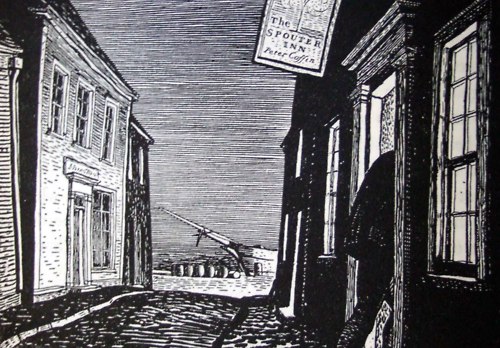
Rockwell Kent's illustration of the Spouter Inn.

Rockwell Kent‘s illustration of the Spouter Inn.

Ishmael heads in the direction of the docks, but is held up when he comes upon the forlorn and dilapidated Spouter-Inn, run by the ominously named Peter Coffin. It stands on a bleak corner, battered by “that tempestuous wind Euroclydon” and advertised by a sign with a “poverty-stricken sort of creak to it”. Yet even the sound of the wind is pleasant when one is indoors and warm. Ishmael takes a moment to meditate on the parable of the Rich Man and Lazarus (Luke 16:19-31), in which the rich man (who Melville refers to as Dives, Latin for rich) allows Lazarus the beggar to die on his doorstep. The rich man is condemned to the fires of Hell, while the beggar Lazarus is taken into heaven. But, Ishmael thinks, would not Lazarus have gone down into “the fiery pit itself, in order to keep out this frost?” With that final blasphemous thought, Ishmael heads into the inn, and the next chapter.

Stray Observations:

  • Ishmael’s entrance to New Bedford is Melville’s first chance to expound a bit on the history of whaling, focusing on the rivalry between New Bedford and  Nantucket for control of the whaling industry. There is a lot more to this story than what’s written here, and if you’re interested in learning more I recommend the excellent documentary Into the Deep: American, Whaling and the World. It’s free to watch online, and great background on the world where Moby-Dick takes place.
  • “Euroclydon! says old Dives, in his red silk wrapper-(he had a redder one afterwards) pooh! pooh!”
  • “Yet Dives himself, he too lives like a Czar in an ice palace made of frozen sighs, and being a president of a temperance society, he only drinks the tepid tears of orphans.”

Chapter 1: Loomings

Call me Ishmael.

Ask a passing stranger to name a line from Moby Dick, and they’ll give you this one. It’s one of the most famous opening lines in all of Western literature, and I would suggest the only opening line in an American novel that can go toe-to-toe with “It is a truth universally acknowledged that a man in possession of a great fortune must be in want of a wife,” or “It was the best of times, it was the worst of times.” It is a succinct and direct introduction to one of the world’s least succinct and least direct books. Perhaps there lies its power.

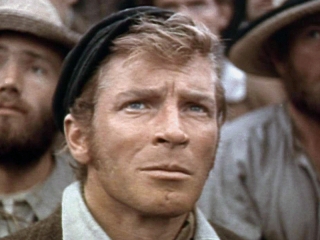
Ishmael played by Richard Basehart in the 1956 film - an appropriately bland white American face for what is often interpreted as a bland role.

Ishmael played by Richard Basehart in the 1956 film – an appropriately bland white American face for what is often interpreted as a bland role.

The line introduces our narrator, but little more than that, for Ishmael is not a major character beyond the first portion of the book. Not only does he do little, he reveals as little as possible about himself, and is easily Moby Dick‘s most colorless figure. Ishmael is our eyes and ears as the bizarre tale aboard the Pequod unfolds, and his non-existent personality and lack of identifying characteristics allows him to operate as a sort of camera-man to the action unfolding around him.

But enough hints are dropped to indicate that he does have a past, not to mention his own motivations and interests. He is a man drawn to the sea, which cures the “damp, drizzly November” in his soul. He talks extensively and knowledgeably of Manhattan, and may have resided there. He has gone to sea before, always as part of the crew, but never as a “Commodore, Captain or Cook”. He was a schoolmaster before taking ship, and is widely read, with knowledge of the Bible and classical mythology. He looks down on aristocrats and idleness, and values work and humility. The lens of an educated but adventurous 19th century American colors his tale, a lens through which Herman Melville viewed the world as well.

ishmael opera

Stephen Costello as Ishmael in the Dallas Opera’s version of Moby Dick.

Particularly telling is his choice of name (we aren’t sure if Ishmael is the name he goes by during the events of Moby Dick, or just the name the narrator gives to us, the reader). The story of the original Ishmael begins in Chapter 16 of the book of Genesis. He is Abraham’s first son, born out of wedlock to the family maid, and disinherited and banished to the wilderness upon the birth of his half-brother Isaac. He and his mother wander in the wilderness but are cared for by God, and eventually he becomes the forefather of an unnamed people, traditionally thought to be the various Arab tribes.

What does this have to do with the Ishmael of Moby Dick? Biblical Ishmael is fated to be an outcast from the moment of his birth. While his mother is pregnant, an angel appears, cautioning her that her son “will be a wild man; his hand will be against every man, and every man’s hand against him” (Genesis 16-12). Biblical Ishmael is doomed from infancy to by driven from his father’s house and wander the wilderness, just as blameless whaler Ishmael is bound to his role in an epic tragedy. But Biblical Ishmael is also fated to survive his struggles and become the father of a great people, which “shall not be numbered for multitude” (Genesis 16-10). Whaler Ishmael is also fated to be the father of something great, but rather than a nation, it is the tale he tells. Despite the personal wishes of both Ishmaels, they are forced into their destined roles, and must play the parts planned for them by God or the universe.

ishmael miniseries

Charlie Cox as Ishmael in the 2011 miniseries, featuring an incredibly irritating and punchable smile.

Most film and theater versions of Moby Dick feature an appropriately bland performance for Ishmael, or make up events to give the character some sort of growth or action. But I like to think that Ishmael is only being modest in his telling of Moby Dick and downplaying his role – after all he is an experienced sailor, and the book suggests that he has traveled to Tahiti, Peru, Britain and other places, either before or after the events described in the novel.

Imagine a dark and smokey tavern on a waterfront, filled with the laughter and curses of sailors on shore for the first time in months. A weather-beaten man, his face craggy and lined from years of sun and wind, sits at the bar. His hands are callused and scarred from years of handling oars and ropes, and the merest hint of a tattoo peeks from beneath the sleeve of his stained and wrinkled coat. You sit down beside him. He smells of the sea.

What’s your story, old man? you ask as he turns his gaze upon you. His eyes are weary from the tropical sun, or perhaps from witnessing terrible things. He speaks.

“Call me Ishmael.”