Chapter 5: Breakfast

This chapter is a short one, but reveals much about Melville’s view of whalemen. Like many people who are vastly talented in one area, they are lacking in others. Whalers, who hunt mighty beasts of the sea and sail for years around the Earth, are not terribly conversational around the breakfast table.

Queequeg, of course, is proud and comfortable even around this slightly awkward and quiet table. using his harpoon, he pulls the steaks over to him, and “eschewed coffee and hot rolls, and applied his attention to beefsteaks, done rare.”

Many of the opening chapters of Moby-Dick have a singular focus on food. Sailors would often subsist on the same meal for months and years, so perhaps this is unsurprising for the opening chapters, set on shore. What people eat is perhaps as revealing as how they eat it. Here we see that rather than a table filled with bawdiness and sea-stories, the men are out of their element, and would perhaps prefer to be back at sea.

On an interesting side-note, while searching for information on the Breakfast chapter of Moby-Dick, I stumbled on the below video of a wave crashing into the Moby Dick restaurant in Santa Barbara.

Chapter 4: The Counterpane

counterpane

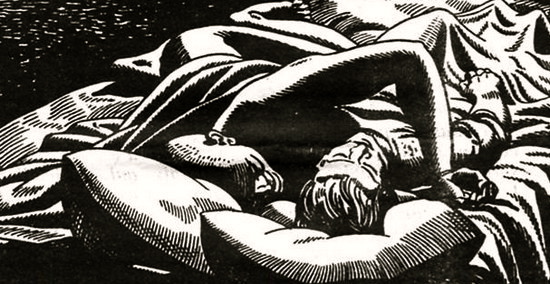
Rockwell Kent’s illustration of Queequeg embracing Ishmael.

Upon waking next morning about daylight, I found Queequeg’s arm thrown over me in the most loving and affectionate manner. You had almost thought I had been his wife. The counterpane was of patchwork, full of odd little parti-colored squares and triangles; and this arm of his tattooed all over with an interminable Cretan labyrinth of a figure, no two parts of which were of one precise shade-owing I suppose to keeping his arm at sea unmethodically in sun and shade, his shirt sleeves irregularly rolled up at various times-this same arm of his, I say, looked for all the world like a strip of that same patchwork quilt.

Many people have commented on the vaguely homoerotic tone of fictional “best buddies” from Sherlock Holmes and John Watson to Batman and Robin. But Ishmael and Queequeg have escaped that scrutiny, despite sharing a bed, sharing possessions, and generally behaving throughout the rest of the novel like a married couple, albeit a chaste one. Despite the fame of Moby-Dick, few people are drawn to comment on their relationship.

The most obvious reason for this is that Ishmael and Queequeg are not the focus of the novel. While their adventures dominate the opening few chapters, they are quickly overshadowed by Ahab and the whale. By the time we meet Ahab, Ishmael and Queequeg are reduced to bit parts in the narrative. However, the extraordinarily close relationship between Ishmael and Queequeg cannot be dismissed as unimportant. It reflects a similar relationship between Melville and the writer Nathaniel Hawthorne, a relationship that not only fueled the creation of Moby-Dick but which continues to provide material for those invested in gossiping about the love lives of dead authors (I count myself among them).

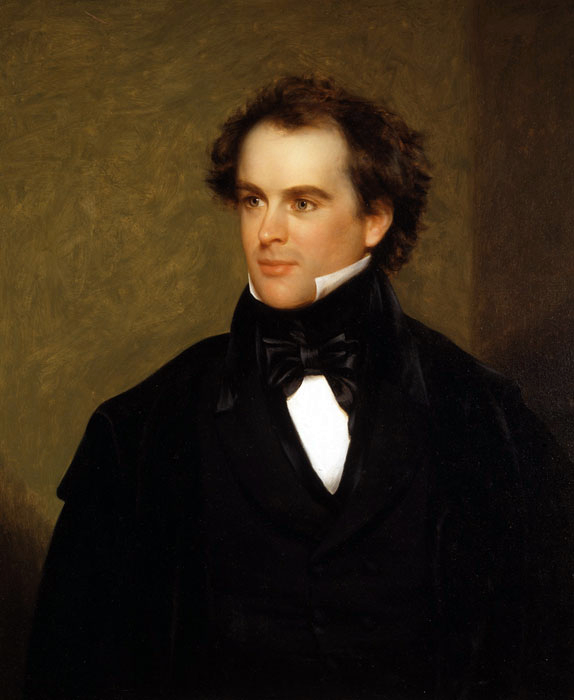
Nathaniel_Hawthorne

A young Nathaniel Hawthorne, painted by Charles Osgood in 1841

Hawthorne and Melville met in 1850, hiking to the top of Monument Mountain in Massachusetts with a group of writers and publishers. Melville was still coming off the success of his first novel, Typee, an exciting tale of high seas adventure in the South Pacific. His encounter with Hawthorne energized him, and their friendship turns Melville away from the popular adventure stories that had been his literary start and to the much more intellectually ambitious work that is Moby-Dick.

While it is unlikely Melville and Hawthorne were lovers, they were a great deal more than friends. Melville, whose letters to Hawthorne have survived, found in Hawthorne a soul mate, a someone who not only responded encouragingly to Melville’s literary ambitions but brought them to new heights. His letters frequently feature phrases like:

Whence come you, Hawthorne? By what right do you drink from my flagon of life? And when I put it to my lips – lo, they are yours and not mine. I feel that the Godhead is broken up like the bread at the Supper, and that we are the pieces.

and:

Your letter was handed me last night on the road going to Mr. Morewood’s, and I read it there. Had I been at home, I would have sat down at once and answered it. In me divine maganimities are spontaneous and instantaneous — catch them while you can. The world goes round, and the other side comes up. So now I can’t write what I felt. But I felt pantheistic then — your heart beat in my ribs and mine in yours, and both in God’s.

In a worshipful review Melville published anonymously under the name “a Virginian spending July in Vermont”, Melville uses intensely sensual language in reference to his friend:

But already I feel that this Hawthorne has dropped germinous seeds into my soul. He expands and deepens down, the more I contemplate him; and further, and further, shoots his strong New-England roots into the hot soil of my Southern soul.

In addition to their frequent letters, the two writers often visited each other. They lived close by, residing in neighboring towns in Massachusetts, and enjoyed drinking champagne and talking late into the night. Influenced by Hawthorne, who had already published his dense and ambitious The Scarlet Letter, Melville took what was going to be a light hearted account of the South Seas whaling industry and transformed it into a masterwork.

Ultimately the relationship between the two didn’t last, as Hawthorne moved away and their correspondence fell off. However Moby-Dick carries a lasting monument to their friendship on the dedication page:

In Token

of my admiration for his genius,

This book is inscribed

to

NATHANIEL HAWTHORNE

Blogging The Whale

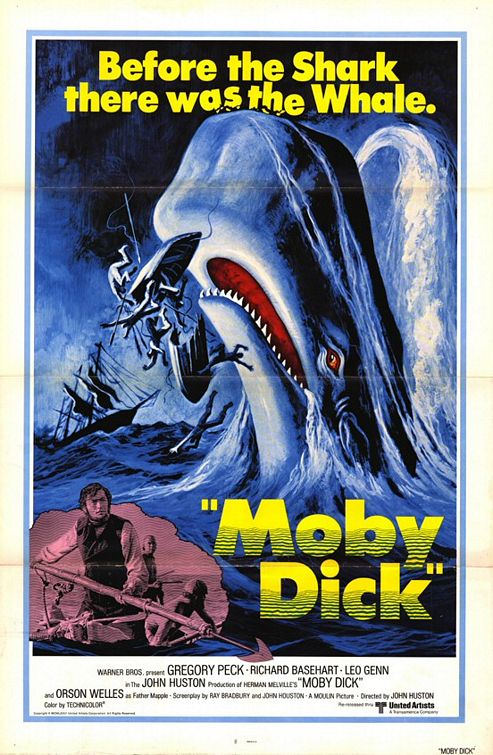
Poster for a 1976 theatrical re-release of the 1956 movie version of Moby Dick


When I was a small child, I saw the 1956 movie version of Moby Dick. I didn’t understand it. The dialogue was incomprehensible, and the visual effects nothing special compared to Star Wars or Back to the Future. But something about the film stuck with me. Perhaps it was Gregory Peck’s depiction of Captain Ahab, with his low growling voice and somber Quaker hat. Or the brilliantly shot ocean setting, filled with soaring seabirds, sails snapping taut in the wind, and singsong shanties. Or perhaps it was the whales themselves, more implied then seen given the special effects of the time, but their bulk and strength still apparent as they awed and frightened the sailors.

I watched the film repeatedly, eventually driving my parents to purchase a VHS copy rather than constantly renting the same film from our local video store. I played at being a whaler, rowing the couch across the living room carpet and harpooning the coffee table with a golf club. While other boys played with trucks or trains, I had a plastic sperm whale that I swung about until its paint and fins wore off. To me, Moby-Dick was the greatest action and adventure film I’d ever seen, flawed only by the occasional extended scene of talking. After a year or so my obsession faded, and I moved on to dinosaurs, 20,000 Leagues Under the Sea, and other more traditional childhood passions.

A few years later I found a leather bound copy of Moby-Dick on my parent’s bookshelf. I was not an early reader, but once I had learned I had become a voracious one. I’d successfully tackled Harry Potter, Animorphs, and Tom Sawyer. Surely Moby-Dick wouldn’t be too much more trouble. I was wrong. By the time I hit the second page I had no idea what Melville was talking about, and I gave up.

But I didn’t abandon the project, returning every few years to hunt for the adventurous sea tale I knew was waiting somewhere within. I skipped anything dealing with free will and destiny, and ignored treatises on morality and God. Instead I zoomed in on the adventure story that rattled about inside the book’s philosophical framework. I found the story of the friendship between Ishmael and Queequeg, a friendship defying barriers of race, class and culture. I found the Pequod, a “cannibal of a craft, tricking herself out in the chased bones of her enemies”. I found the story of a Captain Ahab driven mad by the loss of his leg, who’d “strike the sun if it insulted me,” and pursued the object of his vengeance around the tip of South America and into the Sea of Japan. Through raging storms, lit by the flickering light of St. Elmo’s Fire along the rigging, and against the wishes of his first officer Starbuck, Ahab rolled on, until his rage and madness at last dragged the ship and all its crew but one into the depths of the sea.

I finished the book in high school after several attempts. I could finally say that I had read the thing, and I had no intention of reading it again. Completing it had been a struggle, and most of it had gone over my head, which bothered me. I knew there was more to it than the simple story of Ahab, but I lacked the knowledge required to get the many references to the Bible or classical mythology, or the patience to dig deeper into each passage. In wasn’t until college that I realized that Melville’s book had touched on virtually every subject I studied, from biology to psychology to philosophy and history. The book was like a little world, encapsulating not just a high seas adventure, but also the entire 19th century whaling industry, as well as an examination of the nature of good and evil, an introduction to whale biology as it was understood at the time, and much more. I found myself returning to the book, knowing the story, but looking for what lay behind it. Since then I’ve re-read the novel several times, and can’t say I’ve come any closer to understanding everything that Melville’s masterpiece contains. As each layer of meaning comes clear, it only reveals more ideas and questions to be explored.

By blogging this latest read through, I hope to approach the story from a new angle. I will post once a week on a single chapter, starting from Chapter 1. I’m not quite sure what the nature of many of these posts will be – I’m leaving myself room to write about literary criticism, historical analysis, my own opinions of the characters, or whatever else should strike my fancy. Moby-Dick is a broad book, and it would not do to limit oneself when writing about it.

I also hope that this blog might will inspire readers to pick up Moby-Dick for the first time, or to return to it if they, like many, have given it a try and given up. Moby-Dick is a difficult book, but it rewards perseverance. And I hope this blog can help a little along the way.