If you’ve ever played Dungeons and Dragons, or read a fantasy novel, you’ve seen how an inn always lies at the beginning of an adventure. Here brave companions meet, plots are plotted, and preparations for epic quests are made. Of course inns can be found in other places as well, from the Boar’s Head tavern of Shakespeare’s Henry IV to the Tabard inn of Canterbury Tales. Even the New Testament begins in an inn, albeit an unnamed one. Moby-Dick too has its inn. Here Ishmael meets his closest friend, and a relentless chain of events begins that leads him to his destiny as the last survivor of the Pequod.
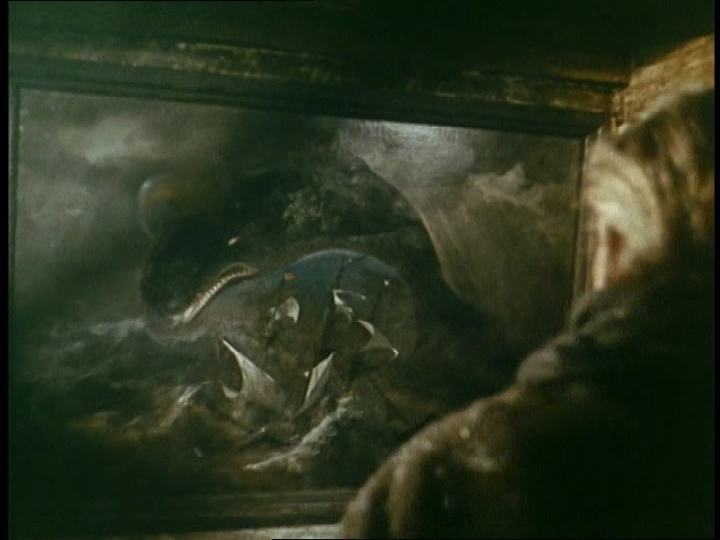
The Spouter-Inn’s whale painting, depicted in the film version of Moby-Dick.
The first thing Ishmael encounters upon entering is a painting, a “boggy, soggy, squitchy picture truly, enough to drive a nervous man distracted.” At first it appears as nothing more than “unaccountable masses of shades and shadows, that at first you almost thought some ambitious young artist, in the time of the New England hags, had endeavored to delineate chaos bewitched.” After peering carefully through the soot and smoke stains that cover its surface, Ishmael soon deciphers a three-masted ship in the midst of a storm, with “an exasperated whale, purposing to spring clean over the craft, is in the enormous act of impaling himself on the three mast-heads.”
Why does Melville devote a solid page to this painting? For one thing it adds to our mental picture of the inn. Dimly lit, and so filled with smoke that it has stained this painting to the point that it is unrecognizable. It also is clearly an image of dread, as we see in Ishmael’s guesses as to the painting’s nature:
-It’s the Black Sea in a midnight gale.-It’s the unnatural combat of the four elements.-It’s a blasted heath.-It’s a Hyperborean winter scene.-It’s the breaking up of the ice-bound stream of Time. But at last all these fancies yield to that one portentous something in the picture’s midst.
The picture isn’t the only decor in the inn. Opposite the painting are hung a number of clubs, spears and other weapons brought back by sailors from around the world, including some “tufted with knots of human hair”. Other implements are famous harpoons and lances, used by legendary whalers or found imbedded in the bodies of slain whales years after they were first flung.
As is common in literary inns, there is no room for the main character. However, he does have the option of sharing a bed with an unnamed harpooneer. Ishmael isn’t a fan of this idea, but would rather share a bed than continue wandering around the frigid town searching for another place to stay. He sits down to supper, “not only meat and potatoes, but dumplings; good heavens! Dumplings for supper!”
As he eats, he begins to hear frightening things about the harpooneer with whom he will be sharing a bed. He is a “dark-complexioned chap”, who eats “nothing but steaks, and likes ’em rare.” Most concerning, the harpooneer is walking about town that night trying to sell a shrunken head, though he isn’t having much success since the New Bedford market is overstocked. Despite that Ishmael is convinced to go to bed, or as the landlord puts it “turn flukes”, and await the arrival of the mysterious man.
When he finally arrives, Ishmael is terrified. The man’s face is “here and there stuck over with large, blackish looking squares”, and he has a “bald purplish head” that looks “like a mildewed skull”. Soon enough it becomes plain to Ishmael that “he must be some abominable savage or other shipped aboard of a whaleman in the South Seas, and so landed in the Christian country.”
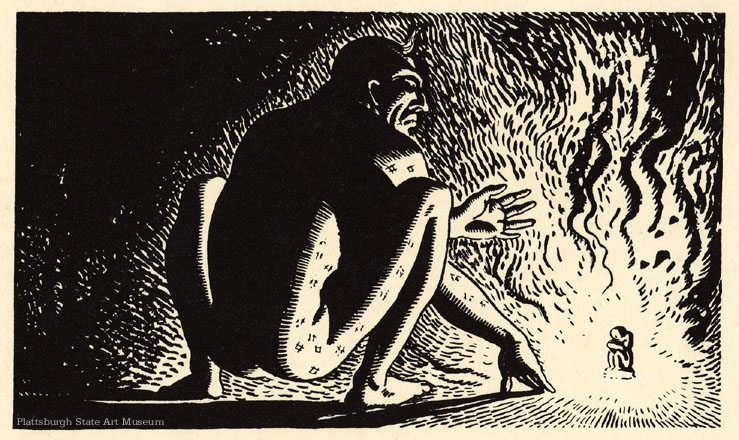
Rockwell Kent’s illustration of Queequeg going about his prayers before bed.
Ishmael, still unnoticed in the bed, watches the man burn wood shavings before a wooden idol he takes from his pocket, and then light a pipe and have a smoke. Finally he climbs in bed, and both Ishmael and the mysterious harpooneer, who understandably had not expected anyone to be in his room, freak out. However, Ishmael’s impending death is avoided by the arrival of the landlord, who calms everyone down and introduces Ishmael to Queequeg, the harpooneer. Both settle into bed and go to sleep.
“What’s all this fuss I have been making,” Ishmael thinks, “the man’s a human being just as I am: he has just as much reason to fear me as I have to be afraid of him. Better sleep with a sober cannibal than a drunken Christian.” In a pre-Civil War America, an America where slavery is still legal and Native Americans are being driven from their lands and homes by settlers, Ishmael’s ideas are virtually unique. But later on, we will see that the world of Moby-Dick is far more open than most in the nineteenth century. Men from all over the world take ship aboard the Pequod, and respect each other as comrades despite their different creeds, races and cultures. This is one of the most appealing things about the novel’s setting, where men are judged first on the work they accomplish and the friendships they form with their comrades. But Melville isn’t trying to push a message of social equality or a utopian ideal. He is simply reporting the attitudes and atmosphere in which he worked aboard a whaling ship himself. Yet without realizing it, he is painting a picture of a better society, one that won’t even be hinted at in the rest of the United States for another century.
Ishmael and Queequeg become close friends, and their relationship is the most well developed in the book, with the exception perhaps of that between Ahab and the Whale. But more on that, and on Queequeg, in the next chapter.
 Devouring a Whale