Call me Ishmael.
Ask a passing stranger to name a line from Moby Dick, and they’ll give you this one. It’s one of the most famous opening lines in all of Western literature, and I would suggest the only opening line in an American novel that can go toe-to-toe with “It is a truth universally acknowledged that a man in possession of a great fortune must be in want of a wife,” or “It was the best of times, it was the worst of times.” It is a succinct and direct introduction to one of the world’s least succinct and least direct books. Perhaps there lies its power.
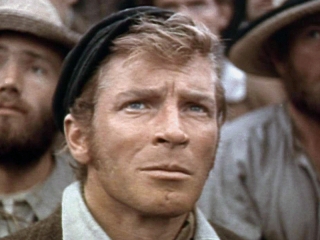
Ishmael played by Richard Basehart in the 1956 film – an appropriately bland white American face for what is often interpreted as a bland role.
The line introduces our narrator, but little more than that, for Ishmael is not a major character beyond the first portion of the book. Not only does he do little, he reveals as little as possible about himself, and is easily Moby Dick‘s most colorless figure. Ishmael is our eyes and ears as the bizarre tale aboard the Pequod unfolds, and his non-existent personality and lack of identifying characteristics allows him to operate as a sort of camera-man to the action unfolding around him.
But enough hints are dropped to indicate that he does have a past, not to mention his own motivations and interests. He is a man drawn to the sea, which cures the “damp, drizzly November” in his soul. He talks extensively and knowledgeably of Manhattan, and may have resided there. He has gone to sea before, always as part of the crew, but never as a “Commodore, Captain or Cook”. He was a schoolmaster before taking ship, and is widely read, with knowledge of the Bible and classical mythology. He looks down on aristocrats and idleness, and values work and humility. The lens of an educated but adventurous 19th century American colors his tale, a lens through which Herman Melville viewed the world as well.

Stephen Costello as Ishmael in the Dallas Opera’s version of Moby Dick.
Particularly telling is his choice of name (we aren’t sure if Ishmael is the name he goes by during the events of Moby Dick, or just the name the narrator gives to us, the reader). The story of the original Ishmael begins in Chapter 16 of the book of Genesis. He is Abraham’s first son, born out of wedlock to the family maid, and disinherited and banished to the wilderness upon the birth of his half-brother Isaac. He and his mother wander in the wilderness but are cared for by God, and eventually he becomes the forefather of an unnamed people, traditionally thought to be the various Arab tribes.
What does this have to do with the Ishmael of Moby Dick? Biblical Ishmael is fated to be an outcast from the moment of his birth. While his mother is pregnant, an angel appears, cautioning her that her son “will be a wild man; his hand will be against every man, and every man’s hand against him” (Genesis 16-12). Biblical Ishmael is doomed from infancy to by driven from his father’s house and wander the wilderness, just as blameless whaler Ishmael is bound to his role in an epic tragedy. But Biblical Ishmael is also fated to survive his struggles and become the father of a great people, which “shall not be numbered for multitude” (Genesis 16-10). Whaler Ishmael is also fated to be the father of something great, but rather than a nation, it is the tale he tells. Despite the personal wishes of both Ishmaels, they are forced into their destined roles, and must play the parts planned for them by God or the universe.

Charlie Cox as Ishmael in the 2011 miniseries, featuring an incredibly irritating and punchable smile.
Most film and theater versions of Moby Dick feature an appropriately bland performance for Ishmael, or make up events to give the character some sort of growth or action. But I like to think that Ishmael is only being modest in his telling of Moby Dick and downplaying his role – after all he is an experienced sailor, and the book suggests that he has traveled to Tahiti, Peru, Britain and other places, either before or after the events described in the novel.
Imagine a dark and smokey tavern on a waterfront, filled with the laughter and curses of sailors on shore for the first time in months. A weather-beaten man, his face craggy and lined from years of sun and wind, sits at the bar. His hands are callused and scarred from years of handling oars and ropes, and the merest hint of a tattoo peeks from beneath the sleeve of his stained and wrinkled coat. You sit down beside him. He smells of the sea.
What’s your story, old man? you ask as he turns his gaze upon you. His eyes are weary from the tropical sun, or perhaps from witnessing terrible things. He speaks.
“Call me Ishmael.”
 Devouring a Whale