
Authentic 19th century carpet bag. All those sailors and buccaneers in your head? They were hauling around their stuff in colorful bags that looked like this.
Several years ago I spent six months studying abroad in South-East Asia. The night before my flight to Manila, I packed everything I thought I’d need into a suitcase, the modern version of the carpet-bag. As I packed, I was filled with both excitement and anxiety. Excitement because I was about to embark on an entirely new adventure, and anxiety because I would be cut off from everyone who I knew, adrift in an unfamiliar culture.
Of course I wouldn’t really be cut off – I had the phone, the Internet, and the mail. I had family members in Manila, and would have plenty of opportunities to make new friends once I arrived in the Philippines. I would be far away, but hardly cut off, either from home or from humanity in general.
Imagine how much scarier it would be to pack your bags for a whaling voyage. There would be no contact with your family or friends once you left. Your clothes would have to last you not just a few months, but several years. During that time your only companions would be the rest of the crew – whaling ships were packed with enough food and water to go months without needing to stop to re-supply. While sailing around the world, you would hardly ever step ashore, leaving the ship only to lower away and do your best to slay a leviathan that could kill you with a flick of its tail.
Ishmael captures a bit of that anxiety as he wanders about New Bedford. He planned to take a ferry to the island of Nantucket, and there find a berth on a whaling ship. But he has missed the ferry, and the next one doesn’t leave until the day after tomorrow. Lost in an unfamiliar town, dragging his carpet-bag, he seeks a place to sleep that he can afford on his meager budget. He turns away from two pricey inns, The Crossed Harpoons and the Sword-Fish Inn, before stumbling on a black church, which he mistakes for an inn:
It seemed the great Black Parliament sitting in Tophet. A hundred black faces turned round in their rows to peer; and beyond, a black Angel of Doom was beating a book in the pulpit. It was a negro church; and the preacher’s text was about the blackness of darkness, and the weeping and wailing and teeth-gnashing there. Ha, Ishmael, muttered I, backing out, Wretched entertainment at the sign of “The Trap!”
This is definitely one of those racially problematic passages one runs into all the time in novels by dead white men from the 19th century, but as usual in Moby-Dick, it’s more complicated than simple racism. One of the book’s dominant themes is whiteness, but whiteness as something unnatural and threatening, something to be feared and hated. The White Whale, the object of Captain Ahab’s obsessive vengeance, is terrifying partly for his unnatural coloring. Blackness, however, is equally threatening in its strangeness – Ishmael is frightened and uncomfortable, and quickly flees. Melville uses this scene to begin establishing his motif of whiteness vs. blackness, using black Americans as a symbol to do so. Race doesn’t play a dominant role in Moby Dick, but it is present – a great essay by David Cope has more on the subject.
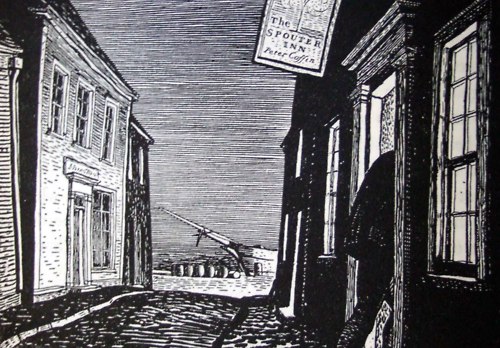
Rockwell Kent‘s illustration of the Spouter Inn.
Ishmael heads in the direction of the docks, but is held up when he comes upon the forlorn and dilapidated Spouter-Inn, run by the ominously named Peter Coffin. It stands on a bleak corner, battered by “that tempestuous wind Euroclydon” and advertised by a sign with a “poverty-stricken sort of creak to it”. Yet even the sound of the wind is pleasant when one is indoors and warm. Ishmael takes a moment to meditate on the parable of the Rich Man and Lazarus (Luke 16:19-31), in which the rich man (who Melville refers to as Dives, Latin for rich) allows Lazarus the beggar to die on his doorstep. The rich man is condemned to the fires of Hell, while the beggar Lazarus is taken into heaven. But, Ishmael thinks, would not Lazarus have gone down into “the fiery pit itself, in order to keep out this frost?” With that final blasphemous thought, Ishmael heads into the inn, and the next chapter.
Stray Observations:
- Ishmael’s entrance to New Bedford is Melville’s first chance to expound a bit on the history of whaling, focusing on the rivalry between New Bedford and Nantucket for control of the whaling industry. There is a lot more to this story than what’s written here, and if you’re interested in learning more I recommend the excellent documentary Into the Deep: American, Whaling and the World. It’s free to watch online, and great background on the world where Moby-Dick takes place.
- “Euroclydon! says old Dives, in his red silk wrapper-(he had a redder one afterwards) pooh! pooh!”
- “Yet Dives himself, he too lives like a Czar in an ice palace made of frozen sighs, and being a president of a temperance society, he only drinks the tepid tears of orphans.”
 Devouring a Whale