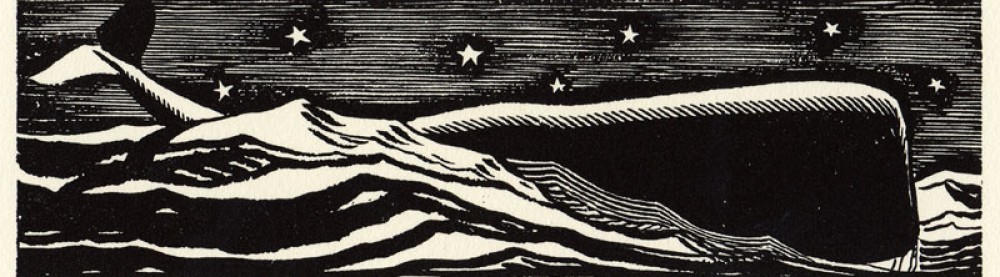
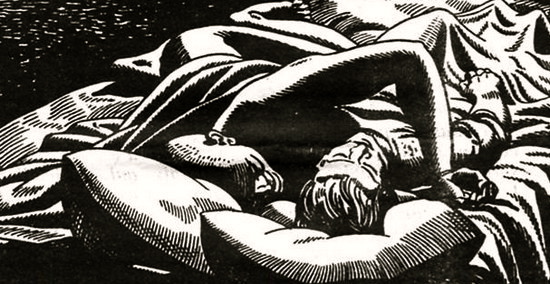
Rockwell Kent’s illustration of Queequeg embracing Ishmael.
Upon waking next morning about daylight, I found Queequeg’s arm thrown over me in the most loving and affectionate manner. You had almost thought I had been his wife. The counterpane was of patchwork, full of odd little parti-colored squares and triangles; and this arm of his tattooed all over with an interminable Cretan labyrinth of a figure, no two parts of which were of one precise shade-owing I suppose to keeping his arm at sea unmethodically in sun and shade, his shirt sleeves irregularly rolled up at various times-this same arm of his, I say, looked for all the world like a strip of that same patchwork quilt.
Many people have commented on the vaguely homoerotic tone of fictional “best buddies” from Sherlock Holmes and John Watson to Batman and Robin. But Ishmael and Queequeg have escaped that scrutiny, despite sharing a bed, sharing possessions, and generally behaving throughout the rest of the novel like a married couple, albeit a chaste one. Despite the fame of Moby-Dick, few people are drawn to comment on their relationship.
The most obvious reason for this is that Ishmael and Queequeg are not the focus of the novel. While their adventures dominate the opening few chapters, they are quickly overshadowed by Ahab and the whale. By the time we meet Ahab, Ishmael and Queequeg are reduced to bit parts in the narrative. However, the extraordinarily close relationship between Ishmael and Queequeg cannot be dismissed as unimportant. It reflects a similar relationship between Melville and the writer Nathaniel Hawthorne, a relationship that not only fueled the creation of Moby-Dick but which continues to provide material for those invested in gossiping about the love lives of dead authors (I count myself among them).
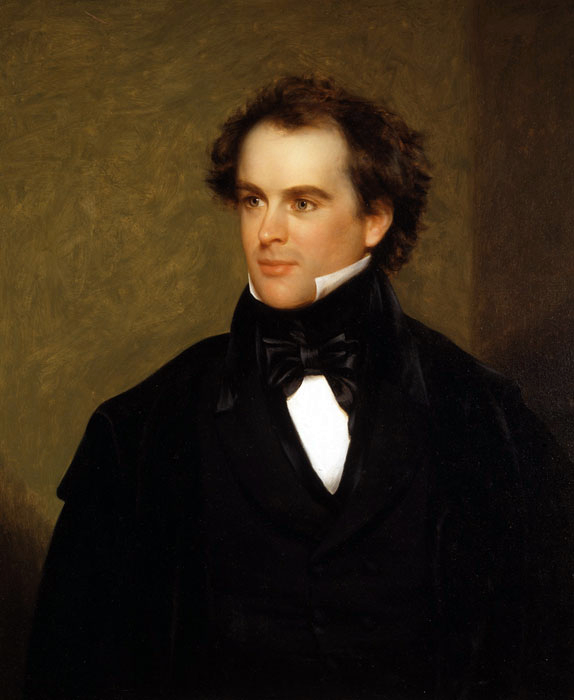
A young Nathaniel Hawthorne, painted by Charles Osgood in 1841
Hawthorne and Melville met in 1850, hiking to the top of Monument Mountain in Massachusetts with a group of writers and publishers. Melville was still coming off the success of his first novel, Typee, an exciting tale of high seas adventure in the South Pacific. His encounter with Hawthorne energized him, and their friendship turns Melville away from the popular adventure stories that had been his literary start and to the much more intellectually ambitious work that is Moby-Dick.
While it is unlikely Melville and Hawthorne were lovers, they were a great deal more than friends. Melville, whose letters to Hawthorne have survived, found in Hawthorne a soul mate, a someone who not only responded encouragingly to Melville’s literary ambitions but brought them to new heights. His letters frequently feature phrases like:
Whence come you, Hawthorne? By what right do you drink from my flagon of life? And when I put it to my lips – lo, they are yours and not mine. I feel that the Godhead is broken up like the bread at the Supper, and that we are the pieces.
and:
Your letter was handed me last night on the road going to Mr. Morewood’s, and I read it there. Had I been at home, I would have sat down at once and answered it. In me divine maganimities are spontaneous and instantaneous — catch them while you can. The world goes round, and the other side comes up. So now I can’t write what I felt. But I felt pantheistic then — your heart beat in my ribs and mine in yours, and both in God’s.
In a worshipful review Melville published anonymously under the name “a Virginian spending July in Vermont”, Melville uses intensely sensual language in reference to his friend:
But already I feel that this Hawthorne has dropped germinous seeds into my soul. He expands and deepens down, the more I contemplate him; and further, and further, shoots his strong New-England roots into the hot soil of my Southern soul.
In addition to their frequent letters, the two writers often visited each other. They lived close by, residing in neighboring towns in Massachusetts, and enjoyed drinking champagne and talking late into the night. Influenced by Hawthorne, who had already published his dense and ambitious The Scarlet Letter, Melville took what was going to be a light hearted account of the South Seas whaling industry and transformed it into a masterwork.
Ultimately the relationship between the two didn’t last, as Hawthorne moved away and their correspondence fell off. However Moby-Dick carries a lasting monument to their friendship on the dedication page:
In Token
of my admiration for his genius,
This book is inscribed
to
NATHANIEL HAWTHORNE
 Devouring a Whale